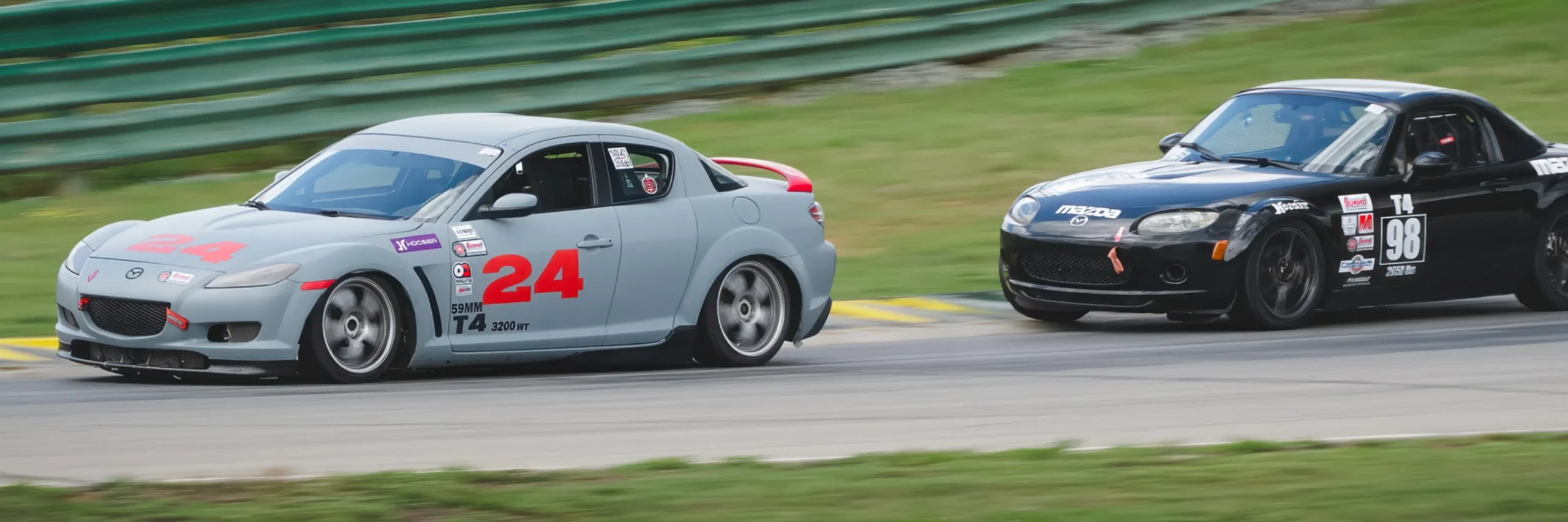
The RX-8 gets misunderstood a lot, even inside its own fan base. People expect a sports car and get a four-door. They expect a turbo and get a screaming naturally aspirated rotary that wants nine grand on the tach before it gives you anything.
None of that is a flaw. It’s the whole point of the car, and it’s exactly why the RX-8 earns its spot in SCCA’s T4 class.
Start with what makes the RX-8 different from every other rotary Mazda ever built. The RX-7’s turbocharged 13B-REW chased power. The RX-8’s RENESIS, a naturally aspirated 1.3-liter two-rotor, chased balance instead.
Mazda moved the intake and exhaust ports to the side of each rotor housing instead of the periphery, which let the engine breathe better at high RPM without forced induction. The result revs to 9,000 RPM and does its real work between 6,000 and 9,000, where most engines are already winding down.
Drive it like a normal car and it feels soft. Drive it the way it’s meant to be driven, deep into the rev range, working the gearbox to stay in the band, and the thing comes alive.
That high-revving nature also demands a different kind of driver discipline than a torquey V8 touring car. You can’t lug it out of a corner on low-end grunt because there isn’t much down there.
You have to plan the corner around keeping the engine spinning. Rev-matching downshifts actually matter, missing a shift costs you real time, and momentum management becomes the whole game. It’s a smaller, more technical version of the same lesson the SRX7 cars teach: the engine won’t bail you out, so the driver has to be right.
The chassis backs that philosophy up. Mazda mounted the RENESIS behind the front axle specifically to chase 50/50 weight distribution, the same design goal that defined the RX-7 a generation earlier.
The RX-8 also runs a double wishbone front and multi-link rear suspension, more sophisticated than what most cars in its weight class get, and it shows up in how the car rotates. Add the fact that Mazda kept the car roughly 300 to 400 pounds lighter than rival sports coupes by skipping the usual six-cylinder or V8 hardware, and you get a chassis that turns in eagerly and holds a line without much drama.
The RX-8’s unusual four-door, four-seat layout, with the rear-hinged “freestyle” doors and no B-pillar, was a packaging trick for street buyers who wanted a sports car they could actually use. On track, none of that matters. What matters is the same low polar moment and balanced weight that made the layout work on the street in the first place.
That’s where T4 comes in. The Touring category groups production-based cars into T1 through T4 by performance potential, with each tier permitted a defined set of changes: roll cage, race seat and harness, stripped interior, limited suspension and brake work, while the car keeps its factory drivetrain layout and silhouette.
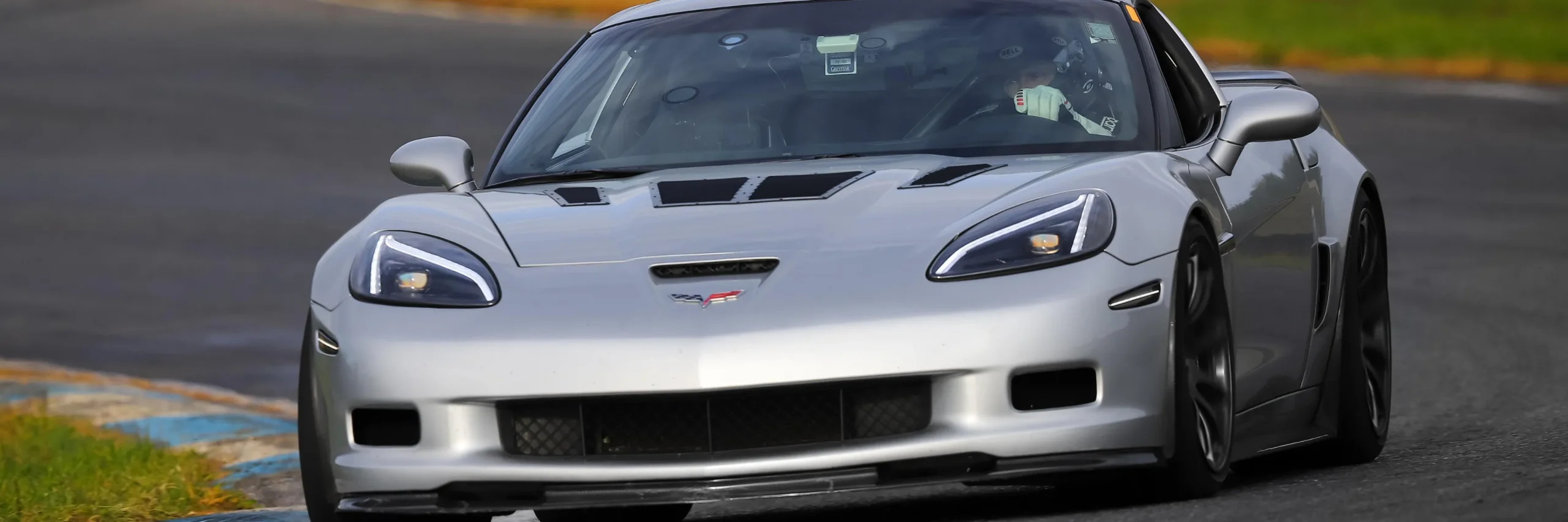
T1 is Vipers and 911s. T4 is the bottom tier, built around cars that were quick but approachable from the factory: Civic Si, Mazda Miata, Acura Integra and RSX, and the RX-8 sitting right alongside them.
The class isn’t about raw speed. It’s about taking a car that was already well-balanced from the factory and adding just enough safety equipment and setup latitude to race it properly, without turning it into something unrecognizable.
That’s a useful frame for newer fans trying to parse an SCCA paddock schedule. T4 cars don’t sound exotic and they don’t have eye-watering horsepower numbers on paper.
What they have is genuine chassis balance and a format that rewards drivers who can extract everything the car has rather than drivers who can write the biggest check. Watching a T4 race closely tends to be more rewarding than watching a straight-line horsepower battle, because the passes happen on braking and rotation, not on raw thrust down the straight.
Running the No. 24 RX-8 in T4 fits the same approach we take with the RX-7s in SRX7. Different decade, different rotary, same underlying philosophy: build the car right, keep it balanced, and let the driver do the rest.
The RX-8 was never going to be the fastest car on a T4 grid. It doesn’t need to be. It needs to do what it was designed to do from day one: turn in cleanly, hold its line, and reward the driver willing to keep that rotary spinning where it actually makes power. That’s the whole case for the car, and it’s the whole case for the class.